


Container ship completes Arctic crossing to UK
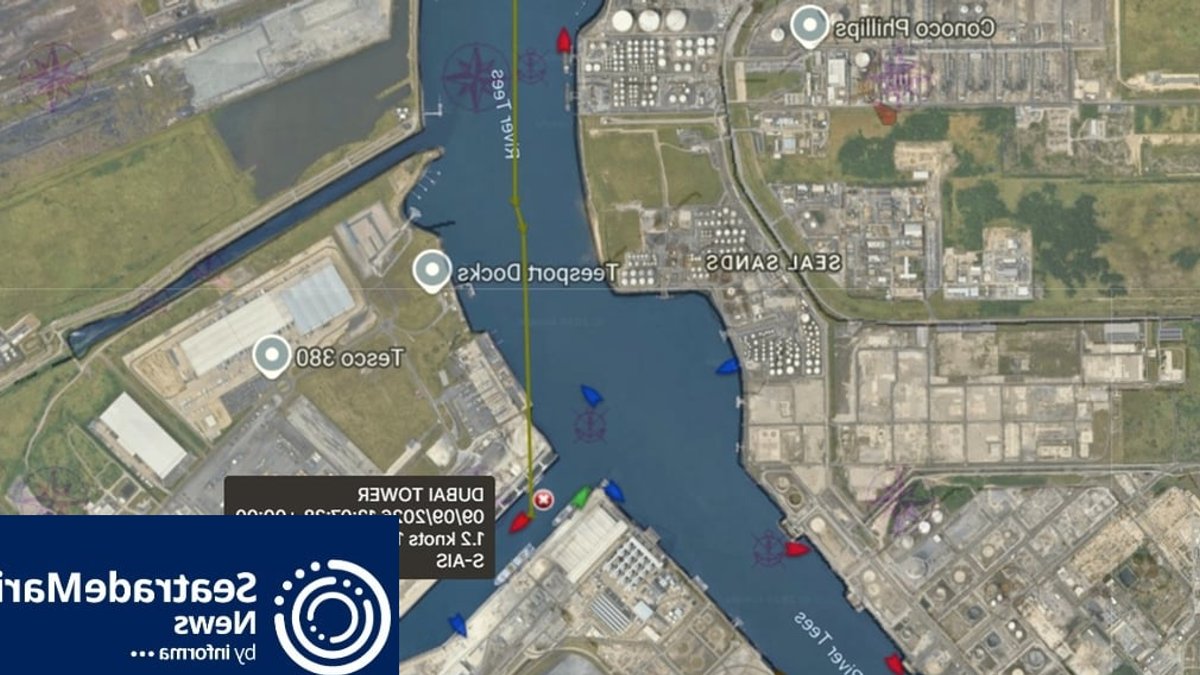
The container ship Dubai Tower, operated by Sea Legend, reached the UK after traveling from Ningbo, China via the Northern Sea Route (NSR) through Russia’s Arctic. Registered in Liberia, the vessel docked at the QEII berth in Teesport, Northeast England, based on AIS tracking data. This stop was unplanned, as Sea Legend had originally intended for the ship to call at Felixstowe instead.
The 1,740 TEU Dubai Tower marks the first of eight scheduled Arctic voyages Sea Legend will conduct this summer under its China Arctic Express Service. The ship departed Ningbo on August 15 and was expected to arrive in Felixstowe by September 5, but the detour to Teesport indicates operational adjustments along the route. The QEII berth, typically used for bulk and project cargoes, is accommodating containers for the first time in this context.
Taking the Arctic route reduces transit time between Asia and Europe by roughly half compared to the traditional Cape of Good Hope path, which requires 40–50 days. However, the NSR is only accessible during summer months when Arctic ice recedes enough to allow passage. These seasonal constraints keep the route as a specialized option for container shipping.
More carriers join Arctic shipping rush
Sea Legend is part of a broader trend, with other carriers exploring the Arctic path. New New Shipping and OVP Shipping, both Chinese operators, have launched Asia-Europe services via the NSR. Meanwhile, PanStar, a South Korean company, is midway through its first Arctic voyage aboard the PanStar Arco, a 2,758 TEU vessel currently off Norway’s coast with 737 TEU of loaded containers onboard.
The Arctic’s increasing use reflects broader changes in global trade logistics. Last year, 103 transit voyages passed through the NSR between June 30 and November 30, involving 88 vessels. Of these, 15 were container ships, with eight traveling eastbound and seven westbound. Tankers dominated the route, accounting for 34 voyages, showing that liquid bulk cargo remains the primary user of Arctic passages.
While the NSR offers faster transit, its long-term viability depends on overcoming key challenges. Seasonal ice conditions and regional geopolitical stability introduce uncertainty. Infrastructure limitations—such as limited port capacity in Arctic hubs, could also restrict growth. For now, the Dubai Tower’s arrival represents a key development, but whether the Arctic becomes a permanent trade corridor depends on addressing these obstacles while protecting the environment and regional stability.
Ports adapt as Arctic trade grows
Teesport’s inclusion as an unplanned stop highlights how carriers are adapting to the NSR’s demands. The port’s bulk-focused facilities handling containers may serve as a temporary solution rather than a long-term strategy. If Arctic trade expands, dedicated container terminals in Arctic ports could become essential to support the growing traffic.
Sea Legend’s service operates only during summer, making the Dubai Tower’s voyage one of the last chances this year to assess the route’s practicality for container shipping. The company’s decision to reroute to Teesport, despite the port’s lack of container specialization, shows the need for flexible logistics in this new trade corridor. Whether this approach becomes standard or remains an exception will determine the Arctic’s future role in global shipping.
The PanStar Arco’s current position off Norway’s coast with 737 TEU of loaded containers demonstrates the route’s growing activity. This vessel’s progress, combined with the Dubai Tower’s arrival, shows the Arctic’s evolving importance in connecting Asia and Europe. However, the success of these trials depends on resolving operational and environmental concerns before the route can fully integrate into mainstream shipping networks.

Drought Redefines Inland Freight Risks TT Club Warns


