


Drought drives Dutch and German recyclers to adapt
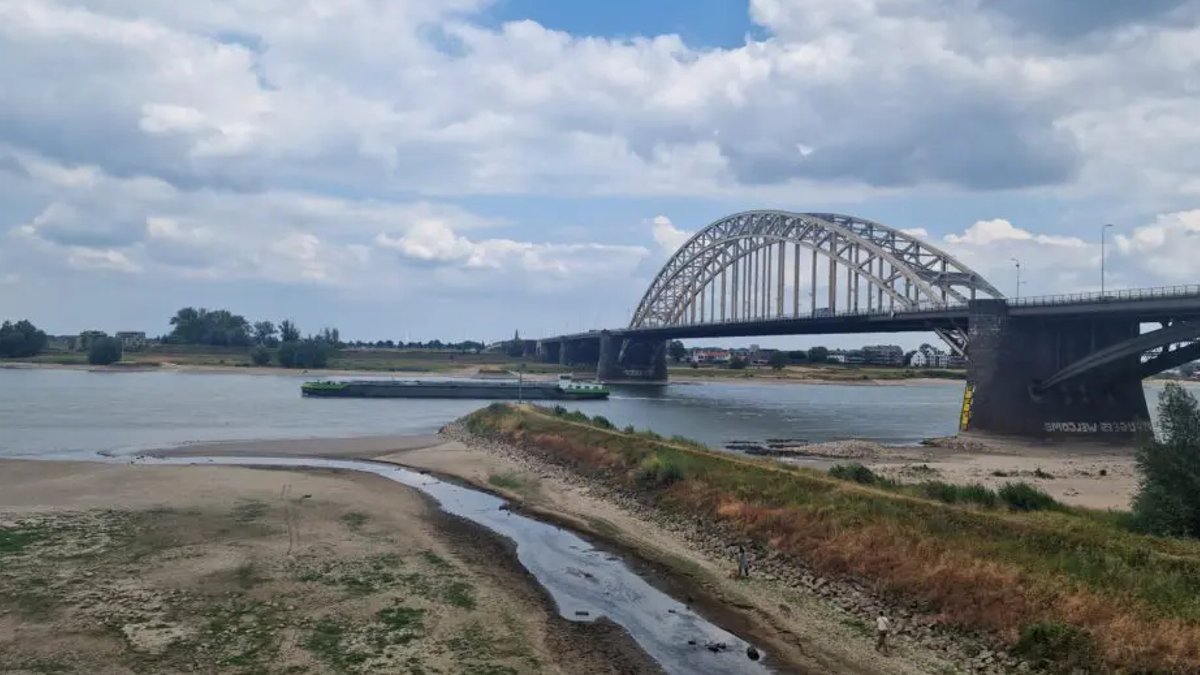
Low water levels across Germany and the Netherlands are forcing the recycling industry to rethink its logistics, as barge transport becomes slower and more expensive. Weeks of hot, dry weather have pushed rivers like the Rhine, Danube, and Elbe to critically low levels, creating a daily challenge for companies that depend on inland shipping to move scrap metal and other bulk materials.
At the HKS Metals recycling yard in Nijmegen, plant manager Bart van der Linden says the situation remains manageable for now. “Scrap is a sector that goes up and down. Right now, transport is currently our biggest challenge,” he said. “We should not underestimate what is happening.”
Water levels near historic lows
On the Waal river near Nijmegen, the water level has dropped to around 4.5 meters, close to historic lows. Every 10-centimeter fall forces inland vessels to reduce their cargo by roughly 100 tonnes. From Nijmegen’s Waal Bridge, houseboats now sit almost in the mud. Only a shallow strip of water separates them from the riverbank.
Cargo barges must steer through narrow deep-water channels, making sharp, sometimes unexpected turns to avoid running aground. Spectators regularly stop to watch vessels squeeze past one another safely.
Dutch authorities have acknowledged growing water shortages after temperatures exceeded 40°C in parts of the country. They expect substantial rainfall will be needed before river levels recover.
Related: Recyclers told to use apprenticeships or lose them
Rerouting shipments, switching to trucks
For HKS Metals, those conditions require daily adjustments. The company processes around one million tonnes of ferrous and non-ferrous scrap annually across its Dutch operations, with Nijmegen as a key facility. Van der Linden says the Twente Canal has now closed to shipping for the first time ever. “The government does not make that decision lightly. It shows how serious the situation has become.”
As a result, HKS’s Hengelo facility has switched from barge transport to road haulage. Summer traditionally brings fewer available trucks, while many companies suddenly require extra road transport. Elsewhere, the firm has rerouted shipments via the River Maas instead of the Waal. Although the journey is longer, it remains notably cheaper than transporting scrap entirely by road. “We’re working away at this puzzle the best we can, without having to incur extra costs,” van der Linden said.
The disruption is also reshaping export flows. Normally, German customers account for around 20% to 25% of shipments from the Nijmegen facility. With some destinations now inaccessible by water, material is being redirected to existing customers elsewhere, including Spain, via the port of Moerdijk.
Van der Linden is relieved other customers have stepped in to take on material typically bound for Germany. “So far, we’ve succeeded in finding a home for our recycled products every time, thanks to a dedicated sales and logistics team. In that respect, we’re far from sounding the alarm.”
The same dilemma is playing out across a wider stretch of industry. When a key transport artery like the Rhine shrinks, every business that relies on it — from construction to chemicals — has to scramble for alternatives, and the costs usually ripple outward long before the water comes back up.
Related: Insurers ranked as best employers revealed
No production disruptions yet
HKS has not yet experienced production disruptions. It still has sufficient feedstock to process and enough storage capacity for finished products awaiting shipment. “Obviously, we cannot store everything indefinitely,” van der Linden remarked. “For now, we are using our storage capacity as strategically as possible.”
In Germany, record low water levels on vital corridors like the Rhine have restricted cargo vessel capacities by up to 75%. Many industries face big increases in freight rates — up to EUR 200 per tonne.
Meanwhile, HKS continues to strengthen fire prevention measures as drought increases the risk of yard fires. Scrap is stored further apart and for shorter periods. Thermal imaging cameras continuously monitor stockpiles for hotspots, allowing staff to intervene before a small incident develops into a major fire. “This innovation is nothing new for us. We invested in this technology many years ago,” van der Linden remarked.
For now, he remains pragmatic. “The yards are certainly not coming to a standstill. The question is simply: how long this heat will continue? How long until we feel the consequences of this heat?”

Recyclers told to use apprenticeships or lose them


